Labels

Saturday, May 3, 2014

Convergence

Doing IT work for a paycheck, playing the piano two to four hours a day, reading literature, playing tennis, being in a loving, committed relationship, tending to family, caring for pets, maintaining a household, going to church, cultivating friends. Lots of pieces that often don’t fit neatly together.  They all are important to me, but where are the common threads?

At least a few of them were nicely woven together for me by George Saunders Congratulations, by the Way: Some Thoughts on Kindness.  This tiny book is a cleaned up version of his 2013 Syracuse commencement address. It's short and conversational, a good example of the new style of commencement addresses by famous people: low on formality, high on sincerity.  Saunders is a great fiction writer. His stories are full of imagination, complexity, and contradictions.  They challenge and puzzle us, but his commencement address is by comparison simple. How refreshing that a leader in the intellectual world reminds us about the importance of spiritual values, of kindness, of the need to combat selfishness, and of the purity and goodness that resides in each of us. It’s a message I hear regularly at church (Unity Palo Alto), but to get it from Saunders does connect a few strands for me.

In the last few years I have learned a few lessons. Making demands, even just politely asking the people around you to treat you the way you want to be treated doesn't usually get you what you want.  The only way to get it is to give it, freely and unconditionally.  No strings, no explanations, no fuss.  Doors will open, doors you perhaps have never seen or imagined.  Give your love, offer your insights and your music, give your best athletic skills and your best attitude on the tennis court, be a good friend, a good worker, be a caring partner. It really is that simple. The rest will take care of itself.


Tuesday, April 29, 2014

The Joy of Paradox

Why do we do what we do? Seemingly we long for something different as we continue to invest in what we have? As soon as we get something different, our longing gets displaced to a new goal, a new difference, a new not-what-we-have.  These issues play out especially dramatically in the realm of romance and life partnerdom, and on that heady subject Adam Phllips, a British psyschoanalyst, Freud expert, and writer teases us with insights, prods, tickles, insults, and caresses. 

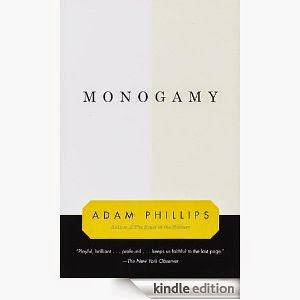
Monogamy is a short monograph comprised of 121 aphorisms or short meditations.  Some are only a couple of sentences, a few as long as two pages.  They remind us that there are no simple solutions, that contradictions abound, and that we can savor those contradictions at the same time that they baffle us.  Better to be amused and intrigued at our complex human condition than to be defeated by the entanglements, or depressed by the failure to find ultimate solutions.

Some samples:
“We work hard to keep certain versions of ourselves in other people’s minds; and, of course the less appealing ones out of their minds. And yet everyone we meet invents us, whether we like it or not. Indeed nothing convinces us more of the existence of other people, of just how different they are from us, than what they can make of what we say to them. Our stories often become unrecognizable as they go from mouth to mouth.
Being misrepresented is simply being presented with a version of ourselves – an invention – that we cannot agree with. But we are daunted by other people making us up, by the number of people we seem to be. We become frantic trying to keep the numbers down, trying to keep the true story of who we really are in circulation. This, perhaps more than anything else, drives us into the arms of one special partner. Monogamy is a way of getting the versions of ourselves down to a minimum. And, of course, a way of convincing ourselves that some versions are truer than others – that some are special.”

“It is not a question of what we belive, but that we believe at all. It is not a question of who we are faithful to, but that we are faithful.
Fidelity shouldn’t always be taken personally.”

“At its best monogamy may be the wish to find someone to die with; at its worst it is a cure for the terrors of aliveness. They are easily confused.”

“If sex brought us in to the family, it is also what breaks us out of the family. In other words, people leave home when what they have got to hide – their sexuality – either has to be hidden somewhere else, or when it is best shown somewhere else.
If you’ve got nothing to hide you’ve got nowhere to go. Which is one of the reasons why couples sometimes want to be totally honest with each other.”

“We can never be quite sure whether we are competing for something that doesn’t exist, or winning a competition in which no one else is competing. This is why in marriage we are never quite sure who the joke is on. Nothing defeats us like success. It is always more baffling – more essentially ironic—than failure.”

“It is often easier to get other people to do what one wants than to get oneself to. So it’s often the person in the couple who isn’t having the affair that wants to, and the one that is that is bitterly unhappy.
We delegate more in our erotic lives than anywhere else. Someone has to do the dirty work.”

“The compulsive monogamist is like the compulsive libertine. For both of them something is too extravagant. For both of them there is a catastrophe to be averted. Monogamists are terrorized by their promiscuous wishes, libertines by their dependence. It is all a question of which catastrophe one prefers.”

“More has been written about how relationships don’t work, than about how they do. We have virtually no language, other than banality, to describe the couple who have been happy together for a long time. We would like them to have a secret, we would like them to have something they could give us. Or that we could give them, other than our suspicion.
There is nothing more terrorizing than the possibility that nothing is hidden. There’s nothing more scandalous than a happy marriage.”

“We begin to feel safe – a litte uneasy, perhaps, but safe – when a new relationship begins to change into a familiar one. When we have settled into our routines, when all the false notes and small misunderstandings have become part of a larger understanding that we call our life together. We don’t need to think about it – or think about it like this – we just enjoy each other’s company. We cannot imagine ourselves without each other. And when we cannot imagine ourselves without each other, we are no longer together.”

“We are never misunderstood, we are just sometimes understood in ways we don’t like. We are never unfaithful, we are just sometimes faithful in ways we don’t like.”

Good stuff.  I need to look at his other books.


Less Is Different

Family Life by Akhil Sharma is a short novel that took twelve years to write.  Many drafts, many revisions, many fresh starts.  Sharma’s difficulties have been well documented.  Some may have arisen from the autobiographical aspects of the novel (and the inevitable emotional consequences), while others are mostly technical. Such is the life of the creative artist.  He deals with the technical aspects of his art.  Those have their own demands, their own momentum.  But if he’s creating something worthwhile, there will also be pains and difficulties akin to childbirth.  He’s extracting (expelling?) something personal, something that will therefore have special value to the reader, and that process can hurt, and it can take time.


Here the question of narrator is paramount.  The story is told in the first person by one of two sons in an Indian family that emigrates to the United States. As the narrator ages his outlook matures, but nonetheless his viewpoint is limited by his age, his nature, and his cultural background.  He sees life in the USA through the eyes of a young recent immigrant, and as such his take can be misleading, insightful, amusing, and sad.  Like Rief Larson in The Selected Works of T S Spivet, or Mark Haddan in The Curious Incident of the Dog in the Night Time, the child narrator (in these cases very special ones) have particular gifts to bestow.  Their limitations are also their strengths.  It’s a way for the author to get us look at things with a fresh (if constrained) perspective.  The limitations here are severe, and the result is rewarding.  This is far from the Indian family epic novel (A Suitable Boy).  There is no sprawling, no horizontal spread of any kind, and little appeal to the senses as well. This is a pared down matter of fact version of events that says as much about the teller as about what is told.


In the end we know what matters to the narrator, but we know mostly because of what is not said, what has been omitted.  It’s a reminder that any viewpoint is limited.  It’s a blow to the heart of the omniscient narrator, and it’s a reminder that humility is never out of place.  Is there a meta-narrator that is offering us this limited view, someone who knows its limitations?  An actor, an impersonator, a master of ceremonies?  Perhaps, but her never makes an explicit appearance.  Except as author.

Thursday, April 17, 2014

But for the Grace of God . . .

To complete my first pass at a Didion survey, I had to read A Year of Magical Thinking. While The White Album and Play It As It Lays have elements of memoir embedded in nonfiction and fiction respectively, this book is pure memoir.  So it seemed logical to go for the pure gold. The personal touch made those two books special, so maybe the unalloyed memoir would be especially rewarding.

Yes and no. The writing is awesomely good.  But the focus becomes unrelentingly personal, and yes, self-indulgent. I recognize that unexpectedly losing a long-held significant other (husband of more than thirty years) must be life changing, Yet I’m not sure I would choose to spend that much time in the exclusive company of the bereaved spouse. The reading experience is meaningful, painful, and revealing.  But I’m not there and I don’t necessarily want to go there with you unless you can relate your experience to aspects outside of your own particular context.

Didion and Donne
I’m not sure that Didion manages to do that. Given a strong will to enter her sealed intimate world I did just fine. But if I resisted going through customs and instead remained in my own world, I did at times lose patience with her unrelenting focus on self, her obvious blind spots to the weaknesses of her loved ones, and her inability to see outsider her own necessarily (I guess) limited view. Reading the book was probably just like spending time with such a bereaved and lost soul.  You can hold your breath and immerse for a while, but every so often you must come up for fresh air and reconnect with your own reality.

Particularly telling:

‘When we anticipate the funeral we wonder about failing to “get through it,” rise to the occasion, exhibit the “strength” that invariably gets mentioned as the correct response to death. We anticipate needing to steel ourselves for the moment: will I be able to greet people, will I be able to leave the scene, will I be able even to get dressed that day? We have no way of knowing that his will not be the issue. We have no way of knowing that the funeral itself will be anodyne, a kind of narcotic regression in which we are wrapped in the care of others and the gravity and meaning of the occasion. Nor can we know ahead of the fact (and here lies the heart of the difference between grief as we imagine it and grief as it is) the unending absence that follows, the void, the very opposite of meaning, the relentless succession of moments during which we will confront the experience of meaningless itself.”

I’m glad if writing the book did her some good. Her mastery of language and technique is stunning. The unrelenting honesty is admirable if at times hard to take. I know that I’ll come back to it if and when I find myself grieving a loved one. For now I’ll file it away as “to be revisited when needed . . . hopefully never.”


Friday, April 4, 2014

Didion's Oblivion

I was so taken with Joan Didion’s The White Album, I had to go on to sample her fiction.  Play It As It Lays is a 1970 short novel. It’s set in the Hollywood scene of the late 60’s, and it is truly terrifying.  The language is sparse; the action not quite the point. The main character, Maria Wyeth, is a young actress who is married to a writer/director. Her life, so promising at times, has completely fallen apart.  Her marriage is a shamble, her daughter is institutionalized, her career is on the rocks.  She has lost all semblance of dignity and self-respect. She has truly entered a state of oblivion where nothing applies, nothing matters, nothing holds. She is not evil, but she is broken and helpless. Didion’s prose keeps us staring at that awful place with no chance to avert our gaze.  The book is difficult to read in places.  I just wanted to put it down and seek some small comfort.  If this is life, then …. why bother?

From the 1972 movie with Tuesday Weld and Anthony Perkins
Sex, alcohol, drugs play a part.  But the characters (there isn’t a sympathetic one in sight) bring their unhappiness on themselves with unwavering determination.  In an effort to be known, to be someone (in the world’s eye), to prevail against the odds, to create something worthwhile, they lose their souls in the torrent of the present.  What’s left is wreckage.  Reading this book suggests what it must be like walking through a disaster zone after a tsunami.  Debris everywhere.  Countless signs of what maybe was, what could have been, but is now simply wreckage.  And there are no signs of rebuilding.  These lives cannot be salvaged.

The degree of condensation employed by Didion is remarkable.  Incidents are recounted in few words.  The narrative jumps around, but one can piece together the timeline.  What remains constant is the inevitable slide into non-functional degradation despite the evident talent and considerable financial resources that remain available. It’s the downside of here-all-things-are possible California. Go ahead, try. The gates of hell are wide open.


Intense, scathing and disturbing, this novel will stay with me.

Friday, March 28, 2014

Where Have I Been?

Joan Didion
It’s one of the best aspects of reading. You can read for a long, long time and still discover an author that makes you wonder how you've missed her for so long.  Joan Didion is not exactly an obscure writer, but nonetheless I’ve managed to avoid reading her. Granted she’s not so popular in New York where I lived most of my life.  But having moved to California, several  readers here have recommended her works as serious and worthwhile. So I picked up The White Album.  Very glad I did.

The White Album is a collection of non-fiction magazine pieces (published in 1979) by the relatively young Didion.  For me it’s a new kind of non-fiction that combines traditional non-fiction, memoir, and many techniques from fiction to make a unique style.  It’s both intensely personal and strictly objective.  No real argument presented, at least not explicity. Just multifaceted takes on some important themes, including the late 60’s, the 50’s, California as a place, technology, feminism, and the personal vs. the collective.

I won’t dwell on specifics here, but suffice it to say that I’ve never read anything more insightful on any of the above topics.  She has a wonderful way of coming at a subject from a number of different angles, all personal, all intensely felt, and all telling.  It’s up to the reader to try to assemble those takes into something coherent.  In some cases it’s not possible, and that’s OK.  It’s a curiously creative approach to non-fiction: impressions, ideas, feeling, all presented as strong but divergent vectors that may or may not add up. It’s Didion’s way of portraying complexity, and it borrows from fiction writers who use different characters (even different narrators) to present divergent views of the same events. Didion manages this in the realm of non-fiction.  The kaleidoscope keeps turning, and the views are striking.

Mark di Suvero sculpture in San Francisco

One might expect that just about anything published on these topics in 1979 wouldn't have much relevance today.  Think again.  These pieces will last for a long time; each is filtered through an intensely personal lens. She presents a series of vectors which precariously balance each other and contribute to a shimmering whole. In the long run we learn more about Didion than about the subject at hand, and I wish I had the opportunity to know her personally in those times.  Well maybe not.  I wouldn’t have been up to the challenge.  I’m grateful to know her through her writing.

Monday, March 24, 2014

Fiction as Argument

“And another thing.  And what about this idea?  But you should really also consider this somewhat contradictory line of reasoning.  This is all messy, but I come down squarely on this side of the argument.”

This is the typical subtext of Dave Egger’s novel, The Circle.  It’s the story of a young woman hired for an entry-level position by a powerful Facebook/Google-like company of the near future.  She quickly rises through the ranks to a position of great visibility, and we as readers witness her gradual conversion to the dark side, to the place where privacy is evil, secrets are lies, transparency is paramount, and human values are essentially lost.  The ending is very dark, indeed.

It’s a long parable.  Parables should last a few pages and be done.  This one goes on for five hundred pages.  Eggers makes his arguments; the points are well taken.  In the end, the debate judges predictably side with the author.

But when I read fiction I’m looking for much more than argument.  I’m hoping for richness of language, depth of character, complex situations where morality is severely strained by the understandable immediacy of human need.  I’m seeking contradictions that both delight and baffle; I’m looking for imagery that glimmers and characters that frustrate.  None of this comes here.  It’s really not a novel at all. It’s an argument thinly disguised as third-person narration of one character’s Google-glass-like take on her experience.  It comes across as adolescent, and is severely
constrained by Egger’s evidently urgent need to make point after point.

I have great respect for Eggers.  I’d love to read the fifty-page non-fiction piece that makes his well-considered argument.  It might well be both interesting and compelling. But the propagandistic novel that he actually wrote requires paragraph-by-paragraph translation from fiction to argument.  Just write the argument, dude.

 That being said I am haunted by Egger’s take on this topic as I go about my daily digital life.  Just catching up on my Twitter feed now has a sinister resonance that it didn’t have before.  OK, I get it.  But I didn’t sign up for reading a long young-adultish quasi sci-fi novel that nags at me like a Jewish grandmother.

It is easy to read, and take into account that I am old[ish].  But go forth with caution. Even dystopian fiction should do more than ask us to track the argument on a scorecard.  We also need to wonder, cry, laugh, and maybe shiver. I'm more interested in the questions than the answers.