Labels

Sunday, November 30, 2014

Masculinity

Many of the stories in Paul Theroux’s new collection Mr. Bones follow a pattern.  We start with a depiction of a character or situation that seems familiar. We’ve seen it ourselves, or we’ve heard of it or read about it, and it makes sense.  Theroux shows us that we only understand the surface.  The complete picture is actually quite different, and often very disturbing.  Behind love can be violence, behind care can be abuse, behind innocence can be perversion, what seems at first to be threatening can turn out to be playful and harmless.  The twists that take us there as readers are sometimes abrupt, but more likely the hints of what’s to come are there from the beginning if we’re paying attention.  The stories are useful reminders that though we have to make assumptions about others in order to navigate the world, we actually know very little about others, and perhaps not so much about ourselves either. The conventions of society keep crucial truths hidden, truths that we choose not to face very often, truths that a skillful writer can bring to light.

Theroux gives us glimpses of many men that unhinged.  Male aggression and violence is a theme that he weaves into many of the stories in one way or another.  Anger and aggression are channeled in lots of different and unexpected ways, some relatively harmless, some with devastating consequences.  Through it all Theroux also explores the role of the writer and his need to write.

Many of Theroux’s novels are place-centric, and of course his travel books are well known.  So I expected that the stories might be shorter depictions of exotic and interesting places.  While some of the stories do take place in unusual settings, the focus is on the characters themselves.  Sometimes the setting is integral to the story, but only as a way of getting to the characters themselves.

There’s not much subtlety or softness here, but rather sharp edges pretty much everywhere.  Yes there is the occasional clumsy turn of phrase or plot contrivance. The female characters are sometimes just as dangerous as the men but more often hollow foils to the aggressive and confused male characters. The plots are not particularly delicate either, and are sometimes a bit gimmicky.  Lots of extremes and hidden agendas, all potentially dangerous and threatening in one way or another.


There’s a reason we hide behind conventions.  We can’t spend much of our time actually living out all of our feelings and desires.  That would be inefficient, messy, and dangerous.  But it’s good to be reminded of the existence of those strong impulses, especially in men.  They do sometimes come out into the open, and even when behind the scenes they can get hold of the controls. If we’ve been paying attention we won’t be so surprised. Look carefully and you’ll see the evidence even in our tame and conventional lives.  Theroux extrapolates to extreme cases for us, but if we retrace diligently we’ll find the sources within ourselves just about every time.

Late, But Finally Onboard

I may be the only English-speaking human on the planet that has not been able to read Hilary Mantel’s two award-winning historical novels.  For some reason I get bogged down fifty pages in and I’m done.  That’s unusual for me; I’m pretty good (some would say too good) at pushing through reading discomfort.  So when Mantel’s new collection of stories, The Assassination of Margaret Thatcher, was highly recommended to me by trusted sources I was concerned that once again I would find myself alone off the Mantel bandwagon.

But these stories are highly polished gems.  They’re not short versions of yet-to-be-written novels.  They’re really stories that work on their own terms.  They’re done when they’re done.  The language is highly calculated but not contrived.  No more is said than needs to be said, and often what’s not said (and left ambiguous) is the just as important.  These are not avant-garde DFW stories, but they’re not in the traditionalist Alice Munro mold either.  They are adventuresome, fresh, and unique in their own ways.  I even like the book’s typography: the abundance of white space nicely reflects the open-ended nature of the stories.  Lots of space to do your own thinking.

The stories with tricky or punchy endings are less successful.  The best ones lead the reader to places, times, and characters with contradictions and unanswered questions.  My favorite is probably “Sorry To Disturb”, but “Harley Street” and “How Shall I Know You?” are very good indeed.  And the title story, though entirely improbable, is deliciously executed.  Savor every sentence.  The ending is masterful.

There are only ten stories, none of them very long, but just about the entire collections is worth rereading.  I find myself thinking about them at odd moments, and I have already gone back to reread a few.


Time to give Wolf Hall another go? 

Monday, November 17, 2014

O welche Lust!

When the prisoners in Beethoven’s opera Fidelio emerge from their dark cells into the light of freedom, they sing a chorus, O welche Lust (Oh, such Joy). Only gradually do their eyes adjust to daylight and their minds to freedom. Such is my reaction on finishing a month reading Solzhenitsyn’s In the First Circle.  The sentence was a long one, and the reading experience not as edifying or rewarding as I had hoped.  But finally, yes, sweet release.

Never read (past tense) Solzhenitsyn.  Nobel Prize in Literature.  Gotta try, right?  Well, I encountered numerous obstacles:
Abandon Hope, All Ye Who Enter Here

It’s long.  Very, very long.  There are many, many characters.  (After all, it’s a Russian novel.)

It relies heavily on a thorough knowledge of Russian philosophy, history, and literature (which I don’t have).

There must be a translation issue, because I found the writing to be very bland and uninteresting.

I came away totally dispirited, to say the least. Yes, there are ‘uplifting’ moments near the end …. The end where the one quasi-heroic figure is hauled off to prison, and a bunch of intelligent men already prisoners and put in an impossible position are hauled off to a horrific labor camp, some as punishment for their lack of cooperation, others for no particular reason.  But uplifting only in comparison to the total desolation depicted in much of the book.  I guess an inch above the floor of absolute despair and meaninglessness is an inch to be treasured, but it doesn’t make for pleasant reading, not by a long shot.

I learned quite a bit about the Soviet Union in the late 40’s and early 50’s with Stalin at the height of his power.  Russians have their own peculiar blend of intellectual rigor combined with intensely felt emotion.  Contradictions abound, and cruelty is everywhere.  Much of what passes for kind and humane in the book is such only in contrast to the stunning lack of collective and even individual caring.  The justifications for that cruelty are long and numerous. And that can make for some pretty oppressive 750 pages.

Only after 200 pages did the book have any traction for me.  The focus is so broad, so many characters with little large action from any of them.  It takes a while to learn to look for the small plot turns that eventually carry the day.  In 750 pages only a few real events take place.  The rest is commentary and a series of side events.  Solzhenitsyn seems more interested in painting a very broad picture of the Soviet Union of the time, so much so that to make a particular tangential point, he simply introduces a new character for a few short chapters, then drops the character totally.  The character was there as an illustration, not as any kind of dramatic player in the action itself. This instead of a deeper dive into the psyche of a few key individuals.

Well, Solzhenitsyn was a very smart and courageous man.  Nobel Prize in Literature I’m not so sure.

I’m hoping to remove the dark glasses soon.  Daylight is painful for now, but I’m ever so grateful for the discomfort. 


Saturday, November 1, 2014

Dr. Murakami

I’m sold.  Have been for a while. A new Murakami book is announced, I pre-order. On arrival, I read it ASAP. That’s how it’s been for me for some time, and the latest book,  Colorless Tsukuru Tazaki was no exception. Is it because of years of therapy? Reading Murakami for me reopens an internal voice, a voice that I learned only with professional help. It’s a voice that has become essential to my ability to guide myself, to know myself, to live as myself.

Very handsomely and expensively printed.
I won’t say much about this particular novel. No need. I don’t think it’s his best work, but it is quintessential Murakami.  For me, just about anything he writes in that special voice will awaken the therapeutic experience.  As usual it’s about a male character who is stuck in life, caught in a period of unhealthy stasis.  The cause is sometimes vague, sometimes clear.  The character’s means of (at least partial) escape is partly psychological, party magical, partly circumstantial.  I liken the approach to that in Freud’s case studies, i.e. Dora.  There’s a problem, there are symptoms and periods of turbulence, there’s exploration, there are dreams, and then there’s a sorting out that leads to tentative healing.

All of that may be beside the point. It may be just the flat unemotional narrative style that appeals to me. That desert is a familiar if unhealthy place for me; I’ve been there many times, and it’s a challenge for me to find my way out.  I have managed it (sooner or later, for better or for worse), and I think reading Murakami’s fiction reassures me that there is always an exit path, no matter how consistently solid the prison walls might seem.  There is an opening if only I could see it. I have constructed the prison myself, and I can also imagine it out of existence.

I’m sorry, we have to stop now. See you next week.


Friday, October 10, 2014

The Power to Please

I recall watching Robin Williams interviewed at the desk on The Tonight Show years ago when Johnny Carson was still hosting.  Williams was absolutely brilliant.  Carson skillfully played the straight man, and Williams changed accents, characters, pace, gesture styles every few seconds.  It was amazing to watch but at the same time it deeply saddened me.  Williams couldn’t NOT do it; because he could please, he couldn’t stop.  He couldn’t just be himself, and to me he seemed manic, desperate and lost.

Of course I have no idea if Williams’s abilities had anything to do with his battle with depression and his eventual suicide.  But I wouldn’t be surprised if his power to please made it more difficult for him to stay in touch with his inner self. 

Celeste Ng’s first novel, Everything I Never Told You tells the story of a teenage girl with the power to please her family (her mother in particular), and also to serve as the glue that held together her fragile immediate family.  In so doing she sacrificed her own pleasures and goals, her own well-being, and ultimately her life.  The story touches on a number of modern themes, including cross-cultural issues and parenting styles.  The approach is very traditional, a straightforward story told in a straightforward way.  We learn about the main character from several points of view.  In the end we piece it all together. The writing is serviceable if not remarkable.  The plot unfolds predictably.  Like The Lovely Bones, we know from the beginning that the girl is dead. The book is about how and why that comes about.

I did learn a few things about my own past.  I too had the power to please my parents, and most often I couldn’t resist it, even when I should have.  I can blame my parents, who to a large extent tried to live through my successes, but I also used their tendencies to avoid my own difficulties, and in the long run those pressures and consequent confusion and pain were my own doing, not theirs.  I don’t think I particularly longed for the applause, but they wanted it for me, and I wanted them to be happy.  If I could provide that, I did, even when I knew (or at least sensed) that there were better paths for me as an individual.

It’s hard enough for an adult to skillfully draw the boundaries between self and others, to navigate the waters in a way that provides both self-fulfillment and strong connections with others.  Children need good models in that way; they need to see the important adults around them make good choices for themselves and lead their lives with appropriate focus and grace.  When parents don’t provide good models, children often make bad choices, or at least choices that may work short-term, but in the long run lead to serious problems.

Ng’s book is an easy read, and I think worth the time if these issues interest you.  If not, move on.


Saturday, September 27, 2014

Doris Lessing

I have a vague memory of hearing about a talk that Stravinsky once gave in which he drew some sketches on the blackboard.  This, he said, represents Wagner’s music.


This represents Schoenberg’s music.

Those are my hand drawn recollections of the sketches, but I trust you get the point.  Wagner had lots of irrational expressionist impulses brewing inside, but he framed them in a strictly tonal structure.  Schoenberg simply removed the frame.

Never read a single work by Doris Lessing.  My bad.  Not sure that Briefing for a Descent Into Hell was the right choice for my initiation.  It is maybe the strangest most complex book I’ve ever read.  It is very much like the Schoenberg sketch by Stravinsky:  stream of consciousness and lots of expressive language with no clear or helpful overarching framework.  It’s up to the reader to figure it all out … or not.  It’s a short book, but not easy to get through.  There were numerous places on the way where I almost gave up.  But it does reward the reader that hangs in.  There is meaning even without the framework.  It’s up to the reader to provide the framework.

Unlike, say, David Mitchell’s literary pyrotechnics, where the foreground might be messy but the overall structure is strict (and where the overall structure actually informs the local narrative), here there is no overall structure.  We float.  We have no idea where we are and what it might mean.  We have no clue where it’s going and what the images might signify.  The reader has to place himself in the same uncomfortable uncertainty (and perhaps insanity) that the narrator is experiencing.  We don’t know where we are, what’s real, what’s not. It's a kind of inner science fiction.

What results is an extraordinary view from a higher level, from an almost god-like point of view that is both enlightening and frightening.  To understand at that level is almost more than a mortal can bear, more than we can handle and at the same time cope with day-to-day life.  Hence the insanity. 

But I take comfort in Lessing’s strong assertion that there is something larger, some bigger purpose, some higher level of existence which really is out there.  In our daily lives we struggle to sense it, but every so often we get a signal that it’s out there.  The book is a kind of mythology about those signals.  If you’re often disappointed by your day-to-day life, take solace.  Read Lessing.


Thursday, September 18, 2014

Thoroughly Unmodern


This isn't just a throwback.  This is what you get when you bring out the way-back machine.  My former colleague Jeannette Haien's second (and last) novel, Matters of Chance, is old-fashioned in many ways.  The prose is the product of a highly educated and intelligent mind, but dated indeed. Quotations from classic literature abound, and the stilted language hangs out there just waiting to be speared.  I wonder if it took a conscious effort from Jeannette to avoid all temptations and references to modernism ... and by modernism I mean anything on the forefront of English literature in the 20th century.  I got used to the style, and ended up not bothered by it, but the prose is very unusual indeed for a book written in the 1990's.

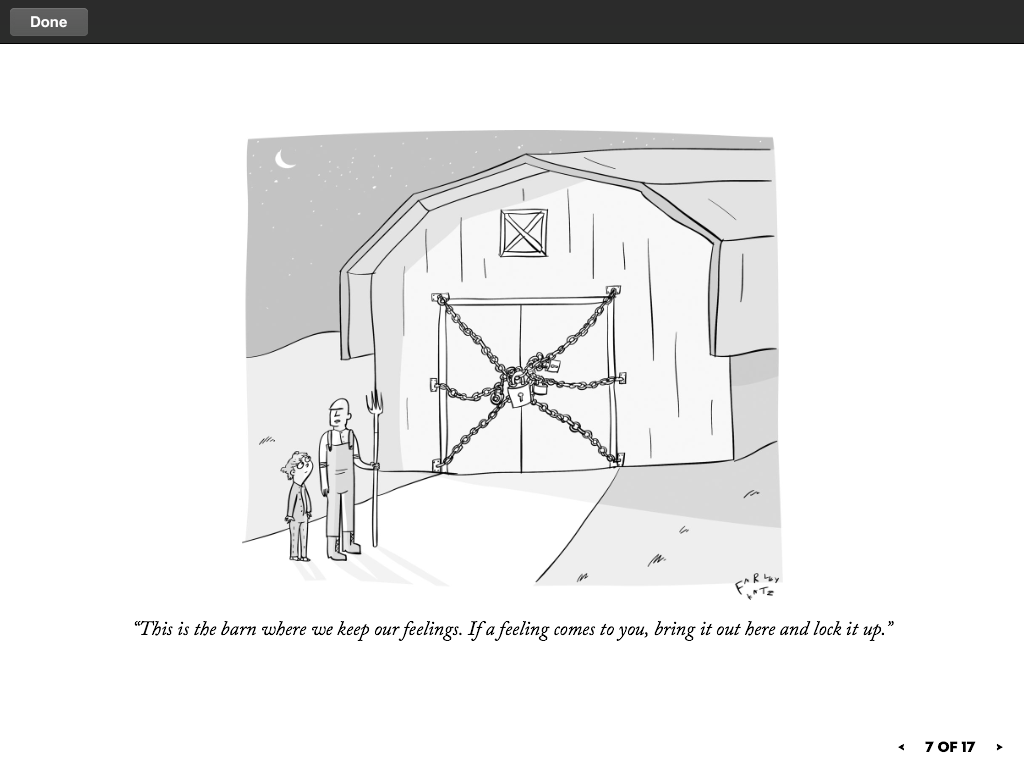
More to the point though are the characters and the story itself. This book is the very embodiment of that 1930's to 1950's approach to life:  Buck it up.  It won't help you to express those feelings, it will only lead you into a self-indulgent black hole, so be strong, be tough, and do what you have to do.  It's a view that I grew up with and know first hand, and it certainly didn't work for me.  But I'm willing to believe that it was appropriate for a large proportion of a few generations that experienced the Depression and WWII.  It got done what had to be done; it got them through. Is it an ideal approach to life?  Well, I guess there really isn't an ideal universal approach separate and apart from a specific cultural and temporal context.

I don't think this book is nearly as successful as Jeannette's first book.  The war scenes are telling, but the second half of the book drags on and on with superficial plot, a surfacy account of lives well led. I wish we had the opportunity to know these characters better, but that's pretty much the point.  They didn't know themselves better, and they didn't want to.  Repression is very useful at times.  But I'm not sure it makes for great fiction.

From a recent New Yorker

Oh, well.  I have great respect for Jeannette.  She was a great musician and teacher.  Her presence would fill a room (yes, often to the uncomfortable exclusion of all others).  There was only one Jeannette.  I witnessed the strength of her convictions on many occasions, and she was a formidable presence.  I urge anyone with an interest to watch her interview with Bill Moyers (you can find it easily).  It does provide a glimpse into her power, her insight, and her moral authority.

Rest in peace.